
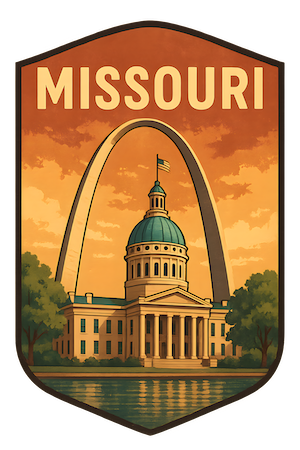
For hundreds of years before European settlers arrived, it was home to the Osage and the Missouria nations, among others. The state’s name actually comes from the Missouria people — it roughly translates to “one who has dugout canoes.” The Osage, meanwhile, were one of the most powerful nations in the region, with territory stretching across what is now Missouri, Kansas, Arkansas, and Oklahoma. The Indian Removal Act of 1830 pushed virtually all of them out. Today, there are no federally recognized tribes remaining in the state.
In 1820, Congress was deadlocked over whether Missouri would enter the Union as a slave state or a free state. The answer was the Missouri Compromise — bringing Missouri in as a slave state in 1821, a year after Maine joined as a free state.
In 1835 Samuel Clemens was born in Hannibal, becoming the literary giant better known as Mark Twain. His childhood home sits just a few blocks from the Mississippi River, a prominent character in Tom Sawyer and Huckleberry Finn. He was a prolific writer, tackling politics of the day with satire, including one of my favorite books–Puddin’head Wilson, which shows the idiocy of the one-drop rule.
Mormon settlers, following the teachings of Joseph Smith, began arriving in Missouri in the early 1830s, believing it was the promised land. Many believe it still is. But in 1838, Missourians had enough of the newcomers and Governor Lilburn Boggs issued what became known as the Mormon Extermination Order — an executive order stating that Mormons “must be exterminated or driven from the State.” About 10,000 Latter-day Saints were forced to flee to Illinois in the dead of winter. The order stayed on the books for the next 100-plus years and wasn’t officially rescinded until 1976.
St. Louis’s Old Courthouse was the site of the first two trials in the Dred Scott case, a landmark (and devastating) Supreme Court decision that pushed the country closer to Civil War. With Missouri being a slave state, many enslaved folks tried to flee across the Mississippi to the free state of Illinois. The Mary Meachum Freedom Crossing shares some of the stories of the Underground Railroad, while in St. Louis, Freedom Plaza honors the enslaved people who sued for their freedom. The state’s devotion to slavery led to it becoming a Confederate state in 1861.
Where the courthouse once stood, you’ll now find the Gateway Arch, a national park designed by two immigrants in the 1960s. Part of that design included getting visitors to the top, but for that they brought in an elevator expert. Dick Bowser took a mere two weeks to come up with the plan to bring five-person pods to the top of the arch–and that is still in use today!
On the other side of the state, Kansas City was the western terminus of the Santa Fe Railroad, but as Western expansion grew, it quickly became a hub for railroad travel and shipping. The original train station was built in what is now known as the West Bottoms (and my personal favorite part of the city), but it was so prone to flooding that they moved it up the hill to the current Union Station.
In th Bottoms and throughout the area, you’ll find seriously delicious barbecue. The whole thing traces back to a man named Henry Perry, who in the early 1900s started slow-smoking meat over an outdoor pit near a streetcar barn and serving it wrapped in newspaper. What makes KC barbecue special is the sauce: thick and sweet. The city has over 100 BBQ restaurants, and what I learned living there is that opinions are very strong about each. For me, I’m a big fan of Joe’s(for pulled pork), Q39 (for burnt ends), and Chef J’s (for ribs).
While I lived in Missouri, I was able to spend my time exploring much of the state, driving to the southeast corner to watch the 2024 solar eclipse with my daughter, discovering more about the origination of the Lewis & Clark Expedition, as well as the Oregon Trail. I visited old Mormon church sites and drove to Branson to see what it was all about. There’s always more to discover (and I’ll be back again later in March!).
Quilt Block
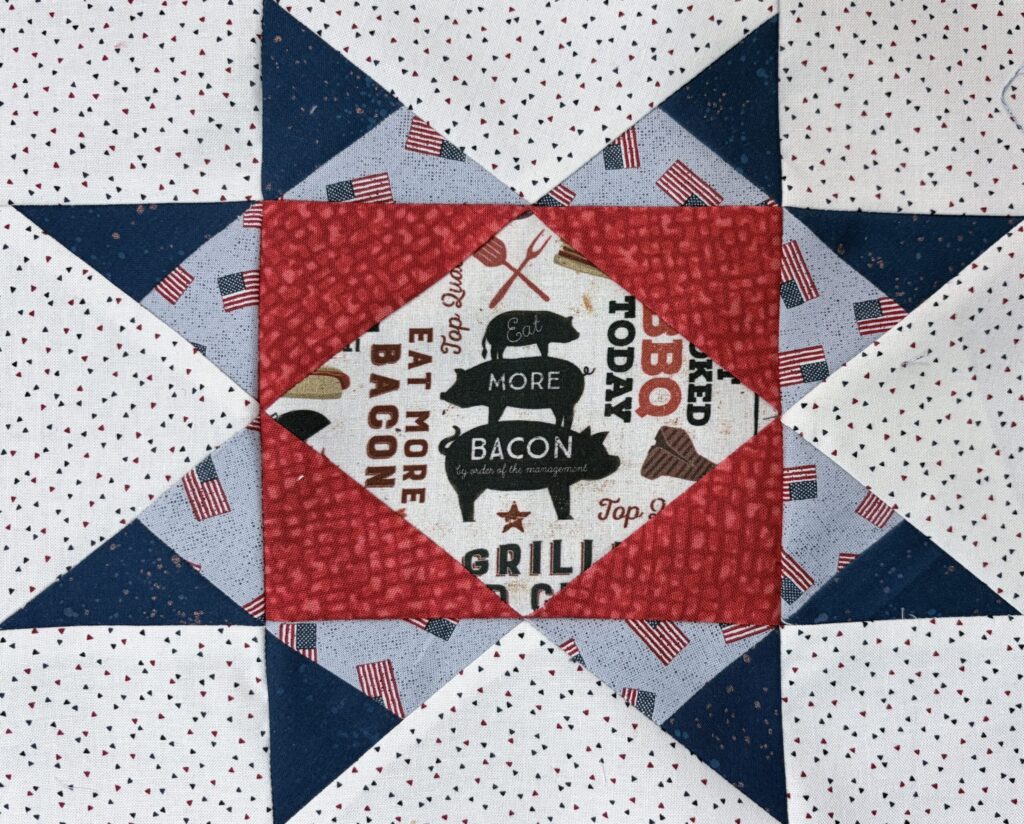
While I thought about doing a different block, it seems that the Missouri Star is too classic to skip. This eight-pointed star design is usually built from half-square triangles, but to make it fit our Quarter Millennial Quilt, it’s done with half-square rectangles instead.
Choose a fun center fabric (I wanted to highlight the bacon and bbq!) and play with the values on the points.
Quilt Shops
Quilts & Quilts in Branson is decidedly larger than it seems from the outside and the rooms flow from one to another, with fabrics grouped by themes. They sell lots (and lots) of kits and Cuddle® fabrics.
Missouri Star Quilt Company in Hamilton is probably the most well-known, though it’s unlike any other quilt shop. With fabrics, notions, tools and machines in eight-plus buildings in the downtown area, it’s fun to visit just to see what it looks like when quilting takes over a town.
Hunters Quilt Mart in Centerview is enormous and off the side of the freeway, so easy to miss. Keep an eye out for it as it’s worth the stop!
The Quilted Cow in Raymore opened just a few years ago and is growing by leaps and bounds. Part of a franchise, it’s a consistent offering between shops with their own personal touches.
Quilting is My Therapy in Liberty is owned by longarm quilter Angela Walters. Not surprisingly the focus is on longarm quilting machines, but there’s a small selection of fabrics, notions and patterns.
O’Sew Personal in O’Fallon is the sister shop of the one in Illinois and offers a range of quilting and Cuddle® fabrics, with regular Lives on Facebook.
Stashworthy Fabric in Parkville has a wonderful selection of Liberty of London fabrics, Tilda fabrics and classic, calico fabrics (and an upstairs clearance section and classroom).
I can’t wait to see your Missouri block! If you live in or have visited Missouri, leave a comment. I’d love to hear more about it!